
When you play a TTRPG by yourself, you're often either generating story and adventure with oracles, or running an adventure meant to be run for you by a DM and ruining half of the surprises for yourself. I hate that. One of the things I've investigated heavily for Bug & Claw adventures is a way to explore different permutations of progressive reveal to help mitigate these problems.
Remember those old Choose Your Own Adventure books? That's one of the more common ways of solving this problem. You scramble up the pages and tell the player to jump to various parts in the book when they make a choice or to see an outcome. If they bother to read the book in sequence, it may not make sense or be valid for their character's play through. This is a valid way I've seen many solo adventure tabletop games laid out, too—referring people to scrambled paragraphs or book sections. But I think there have to be other ways. I want to empower TTRPG designers to create awesome adventures without ruining their payoff for players in advance.
The one outlined above. A page-redirect trick or the paragraph/section book, where a numbered entry directs you elsewhere (e.g. "turn to 239"). In gamebooks, designers deliberately misnumber and scatter entries so you can't read ahead coherently. A variant is to present links inside a map and let the reader "travel" by choosing where to go next. The map itself becomes the index, hiding the order.
This is how the Fabled Lands book series works that I was playing the last couple of years. It was OK but I often couldn't avoid seeing a scary fight or big treasure hoard referenced next to whatever I was reading and have its paragraph number seared into my brain. It felt like cheating, even if unintentional.
One of the most common physical methods I've encountered was popularized by Pandemic Legacy: sealed envelopes and components. You open them only when triggered, sometimes never unlocking some depending on your choices or outcomes, always wondering what was in there. The reveal here is irreversible and ceremonial.
To be honest, I love this method, but I'm not sure how well it fits for TTRPGs or not. It makes sense for big reveals, but less so for smaller, progressive iteration, the way we often dungeon dive. I get the impression it's also very costly to print and package.
When I was a kid in the 90s, it was still common for the odd comic book or magazine to be sold with "decoders" or "reveal glasses." Special optical tools with red filters that conceal or unmask hidden text and images. By filtering out specific color hues, like bright cyan or red, they isolate the underlying layer of a design. These were often glasses tinted red, but could mimic the form of a magnifying glass, a simple window shape, or even a fake Ouija planchette.
I freaking love this method, and I think with the right direction, templates could easily enable the TTRPG community. With enough adoption, you could sell glasses/decoders separately to lower costs, accepting that many players may already have them.

Similar to the above, multi-lens separation goes beyond the single red lens. The book prints three images on top of each other in different colors, so red, green, and blue lenses each separate out a different image, with the other two becoming the mask. Different players could hold different lenses and read different secret information from the same card.
For a game like Bug & Claw, where I'm designing things solo-first, this could have a lot of very interesting implications. A green result could be normal, a blue result could be good/resonant, a red result could be bad/infectious. Alternatively, one colour could be all the solo player reveals while the other colours are what things turn into when there's a group, each one seeing things differently.
I couldn't find any commercial games using this, despite the obvious hidden-roles potential. I am very intrigued here.
We already use physical barriers with in-person group games in the form of the DM screen. There are other forms of this I've seen, too, though, where a player purposely keeps a paper, piece of cardboard, or specific shape on top of what they're reading to obscure certain details. The immediate problem is not knowing what and how much to reveal. If the material is designed so everything is in a concrete row or column of information then it's a little easier to reveal one concrete chunk at a time, but otherwise it can get unwiedly and confusing, in my opinion.
My wife and I have made a ritual of playing an Exit game every New Years / Holiday Season. These games mix a lot of different techniques for solving puzzles that I think TTRPGs could make use of, but one in particular might be of interest to innovative designers: the design from one page mixes with the design on the other side when held of to the light to make a secret message. I admit I love this method, but I think it would be far too taxing as a designer to constantly figure out how to accurately create this reveal. One or two per book, though, could be fun.
I think we're all pretty familiar with writing something backwards and revealing it in a mirror. There are permutations of this that I've seen in the Exit games I mentioned earlier, too, where a single keyword may get revealed by reflecting something horizontally instead of vertically. I think having a mirror nearby while TTRPG gaming could be quite tedious, though. The same goes for the simple "Flip the page upside down for the answer."
The what?!
I know, I had no idea it was called this. I remembered this from a few games when I was in elementary school and never saw it again. It took a long time to reverse-engineer what this was, enough to search for it.
The idea here is simple: the answers, outcomes, or a secret message are hidden inside what you're already reading, and you have a decoder piece with particular chunks cut out of it that will highlight specific words as the reveal. More complex ones had pieces you could add or remove from the frame to change the words that get highlighted.
I also learned about the turning grille (a.k.a. Fleissner grille). This was the same idea but a rotating variant the military used in WWI. The German Army used Fleissner grilles in late 1916. The reveal mechanic here is rotation, where the same mask, turned 90° four times, exposes four different letter-sets.
I absolutely love these methods that've been lost to time, but probably not for a typical TTRPG where you want to move around a lot and explore.
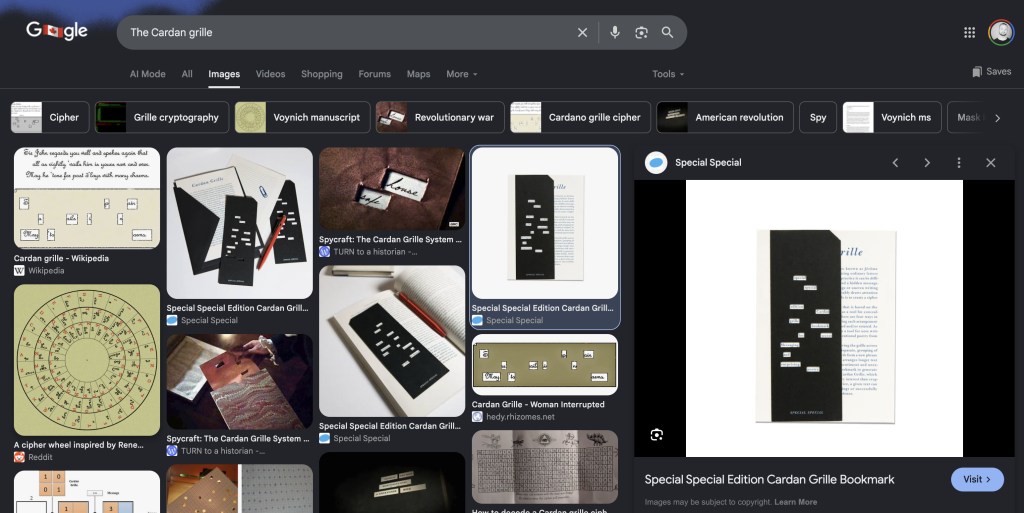
Another old-school method I found while looking into Cardan grilles that I think the right game could make use of is the Moiré interference method, which involves overlapping patterns and screens to reveal secret messages and images through the "interference" between them. Not for me and Bug & Claw, but I could see a map/dungeon designer having a heyday with this. I couldn't find any decent images that really get the idea across well though.
Again, taking inspiration from the Exit games, which use these in every single one that we've played, a "volvelle" style decoder disc gets you to rotate several attached rings to decode a message. Reminds me of the dragon claw ring puzzles from Skyrim. In the more complex Exit games, the centre of these discs sometimes has multiple reveal spots cut out, or even one on the backside!
I think this type of thing could definitely be reused for TTRPGs, but not for much longer than a short adventure. You could use it to determine whether an action's outcome was successful in a neat way, but eventually you'd get used to certain results and start memorizing them.
I swear it was also one of the Exit games that did this, but it may have been a different game we played a few years ago, where we held a heat source up to the paper, and it revealed the answer. This could be a pretty cool way to progressively go through an adventure, revealing the paragraphs you've chosen. The alternative could be a special felt-tip pen that reveals hidden text, like the one I used to have as a kid.
When playing a narrative or roleplaying-based game solo, it can be hard to ge tinvested in the story when you can't help but see some of the upcoming details. We need a way to progressively reveal information for ourselves, maintaining some mystery. So far, if I get my way, there's a clear winner above for Bug & Claw. Can you tell which one it was? What kind of innovative methods are you incorporating into your games?
